1.1.3 Evolution of ROS
ROS is a long-standing, large-scale software project with numerous contributors. Even before ROS emerged, many scholars recognized the need for an open collaborative framework in robotics research, and several similar projects had already worked towards this goal. Among these efforts, Stanford University conducted a series of related research projects in the mid-2000s, such as the STandford AI Robot (STAIR) project and the Personal Robots (PR) project. Through these projects, which focused on studying representative, integrated artificial intelligence systems, a highly flexible and dynamic software system for indoor environments was created, which could be applied to robotics research.
In 2007, Willow Garage provided substantial resources to expand and refine the software system from Stanford's robotics projects. Meanwhile, through the collaborative efforts of countless researchers, the core concepts and fundamental packages of ROS were gradually improved.
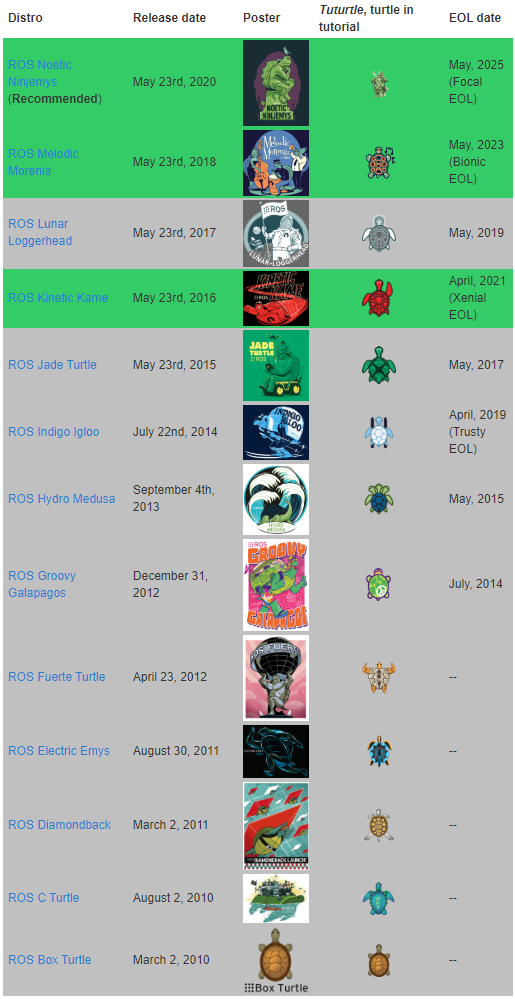
A ROS distribution refers to a versioned set of ROS packages, similar in concept to Linux distributions (such as Ubuntu). The purpose of releasing ROS distributions is to provide developers with a relatively stable codebase until they are ready to upgrade everything. Therefore, after each distribution is released, ROS developers typically only fix bugs for that version while providing minimal improvements to core packages.
Version Characteristics: ROS versions are named in alphabetical order. ROS has now released the final version of ROS1: Noetic, and it is recommended to eventually transition to ROS2. Versions prior to Noetic defaulted to Python2, while Noetic supports Python3.
Recommended versions: Noetic or Melodic or Kinetic
Other References